Posted by KA9NWM
Once the website was in good shape, the rest of July turned into the busiest, most concentrated stretch of the whole project so far. I want to walk through the real shape of it, because a lot of it was research and rebuilding as much as it was new features.
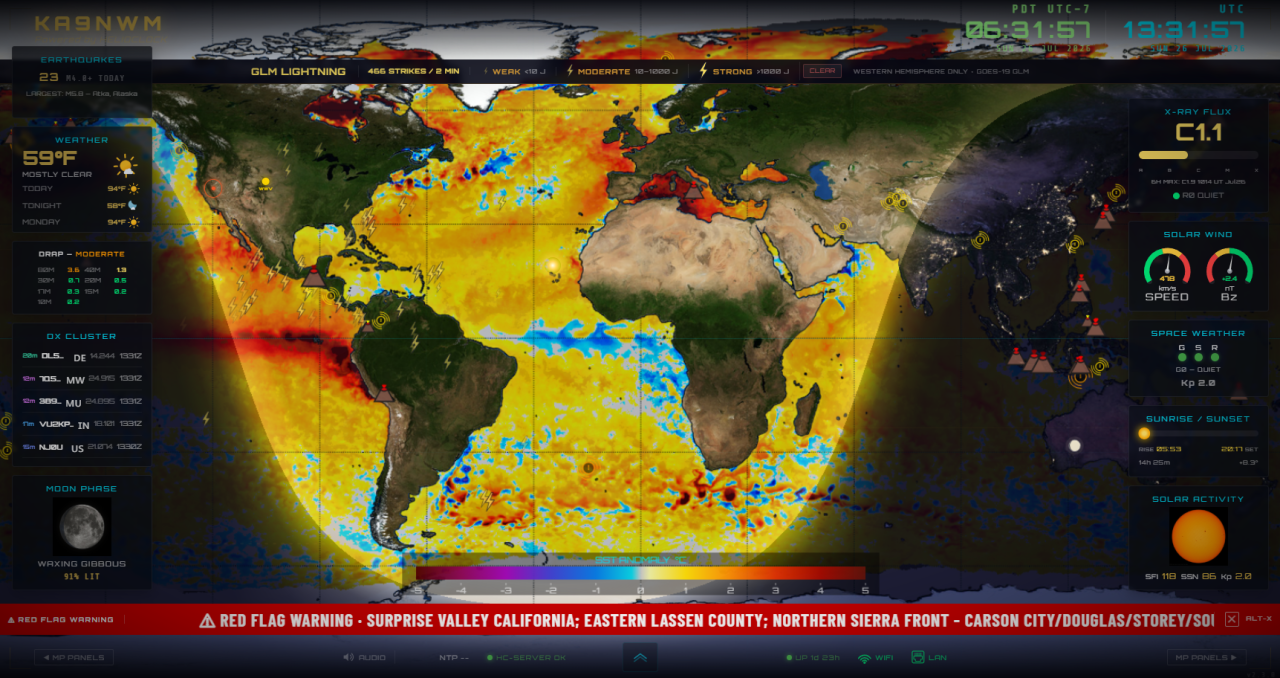
It started with an honest question: what does HamClock (the original) and OpenHamClock (the actively maintained community fork) actually do that Helioclock doesn't? I went through both in detail rather than guessing, and came away with a real gap list. I picked off the easy ones first: a Dst index panel using USGS's public-domain data, and then worked up through harder items. That led straight into building a MUF Matrix map layer from real propagation science, which meant reading actual historical source material, the original MINIMUF-3.5 BASIC code from 1978 and the MINIMUF-85 equation from a 1990 Naval Research Lab memo, rather than trusting a plausible-looking summary. That research paid off almost immediately: a user-submitted document claiming to be MINIMUF-85's architecture turned out to have the telltale signs of being AI-fabricated, and I'm glad I checked the primary sources before building anything on top of it.
That gap analysis is also where Best Band Now was born, and it became the single biggest feature of the month, in three real rounds. The first version correlated my propagation model against live DX Cluster and PSK Reporter activity with a tiered CONFIRMED/LIKELY/SURPRISE/CLOSED system. Round two added Reverse Beacon Network data as a fourth evidence source. But a live screenshot in the third round exposed a real structural flaw: a band with only 4 spots could still outrank a band with 66, just because it sat at a higher frequency. That wasn't a bug to patch, it was a wrong model, so I rebuilt it from the ground up around genuine evidence strength, with a real decision log validated against a data set of thousands of actual band-decision records before I trusted it. PSK Reporter and POTA both got pulled out as Best Band Now confirmation sources along the way, not because they're bad data, but because in practice they read zero too often to be useful signals, even though the standalone panels for both are untouched and still live.

A good chunk of July also went into features that make the display genuinely useful beyond propagation: POTA, SOTA, and WWBOTA panels and map layers, a real UDP listener for live WSJT-X and JTDX decodes and a FAA Weathercams panel covering 955 real camera sites, which took a genuinely stubborn debugging session to get right (a CSS flexbox quirk was silently collapsing the results list to zero height, and it took real discipline to stop guessing at the JavaScript and check the actual rendered layout first).
I also built something a little different: a set of real broadcast-style display test patterns (SMPTE color bars, HD color bars, grayscale, crosshatch, geometry) hidden in Settings, mostly because I have decades of broadcast background and it felt wrong not to include something like it. It was a nod to my TV career but it is also useful for SSTV enthusiasts.
The back half of the month shifted toward Huntsville itself. All three installer scripts (the N100 appliance installer, the USB stick installer, and the Raspberry Pi OS installer) got a full audit and, in places, a real rebuild: display detection fixed for Wayland instead of assuming X11, screen-blanking suppression that actually works, Chrome keyring prompts silenced, and a full regression test script to catch problems before they ship rather than after. And with a real booth now on the calendar, I moved into the business side I'd been putting off: setting up Stripe for card payments at the show, and figuring out simple, affordable packaging for the SD cards and USB sticks I'll actually be handing to people in person.
By the end of July, Helioclock had a genuinely rebuilt propagation feature I trust, several new ham-radio-specific data sources, hardened installers across all three SKUs, and the unglamorous business groundwork done to actually sell something at a booth. It's the month where this stopped being just a development project and started being a real product with a launch date.
Oh, and a final note. My second bench test system ran unattended with no errors for 41 straight days. I finally had to update the software in it to end that streak, and I was actually a bit sad to do so.
73,
Anthony, KA9NWM